
Case Study: Onboarding of Union Bank
Context
During a major platform merger at U.S. Bank, our team was tasked with enhancing the onboarding experience for mobile banking users. The objective was to ensure a consistent and seamless experience for both new users and existing U.S. Bank Systems. Our goal was to deliver a friendly, trustworthy, and informative experience that showcased new features and the U.S. Bank application.
Tools
Figma, Accessibility Standards, Financial APIs, Stakeholder Workshops
Services from Union Bank
500 Billion in assets and cash
28 Diffrent User Accounts not including multi accounts
Title/ Team build
Lead Experience Designer (myself)
3 content designers
1 accessibility consultant
4 designers (overseas)
3 development teams

Union Bank Case Study
U.S. Bank / Union Bank— Designing the Onboarding Experience During Platform Merger
The Challenge
During the merger of U.S. Bank and Union Bank, our team took on a high-stakes challenge: unify two very different mobile banking experiences into one seamless platform. For both new and existing customers, onboarding would be their first real impression of the merged bank, and in financial services, that first impression is where trust is won or lost. Friction or confusion at sign-up meant real risk to adoption and retention at scale.
My Role
s UX Architect / Product Strategy Lead, I led the design of the onboarding experience for incoming Union Bank customers, a group unfamiliar with U.S. Bank's app and expectations. The goal was an onboarding process that felt straightforward, trustworthy, and human, while holding up against the security and compliance standards that come with operating in a highly regulated industry. I led a team of 11 across content design, accessibility, and engineering to get there.
Approach
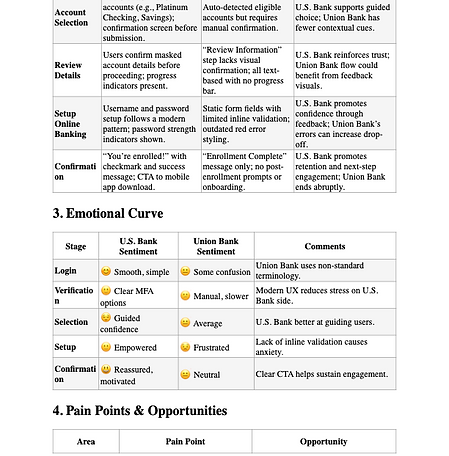
Research first I ran usability tests with customers from both banks and with Union Bank subject matter experts to find where the existing workflows broke down and where the two banks' assumptions about onboarding didn't match. I compared those findings against competitor fintech apps to identify what best-in-class onboarding actually looked like, then brought the findings to stakeholders to help shape the approach and decide which features actually mattered.
Journey mapping, at scale We mapped the entire flow, from opening the app for the first time through account setup and login, looking for every place we could cut a step or remove a redundant verification request for Union customers moving to the new bank. This became the most extensive journey map I've ever built, large enough that I ran into the app's own memory limits putting it together. That scale was the point: the merger touched more edge cases and legacy assumptions than a typical onboarding redesign, and the map had to hold all of it to be useful.
Consistency through the design system I applied the enterprise design system I'd helped build, adapted as a white-labeled version aligned to Union Bank's brand guide, so visuals, typography, and interaction patterns stayed consistent across both platforms. That consistency mattered most for Union Bank users encountering U.S. Bank's product for the first time, familiarity lowered the guard they'd otherwise have going into a new banking relationship.
Trust through transparency. Identity verification is exactly the kind of moment where users get nervous, so we built in universal footer microcopy, a visible progress indicator, and accessible UI patterns that explained each step in plain language as it happened. Nothing about the process asked for blind trust.
The Solution
We rolled this out in two phases. Phase one was a standalone website explaining the merger and previewing what was changing over the coming months, so customers weren't caught off guard the first time they opened the app. From there, we streamlined onboarding across platforms, cutting the time to first login by simplifying registration and verification so returning customers only needed to enter new login credentials rather than re-verify everything from scratch. A contextual guide, transparent progress indicators, and ADA-compliant design walked new-to-bank customers through each step, keeping the transition between legacy Union Bank and U.S. Bank consistent rather than jarring. We also built an in-app introduction tour using Pendo to highlight features Union customers didn't previously have access to, and added a paperless sign-up interstitial that stakeholders had specifically asked for.
Impact
-
25% reduction in drop-off during onboarding
-
73% paperless adoption
-
91% satisfaction score in usability testing for new-to-bank customers.
The Outcome
By unifying the onboarding experience, we made sure thousands of incoming Union Bank customers felt supported rather than dropped into an unfamiliar system. Beyond the first-impression win, this work laid the foundation for long-term digital engagement across the merged platform, and gave the rest of the merger's product teams a proof point for what a well-run, research-backed transition could look like.


_tiff.png)
.png)


